
Darlington Parole and Probation Compared
South Carolina places parole, probation, pardon services, and several forms of community supervision within the South Carolina Department of Probation, Parole and Pardon Services, or SCDPPPS. That shared agency does not make the terms equal. Parole follows confinement and is authorized for an eligible sentence by the state Parole Board. Probation comes from a court and may replace incarceration or follow a custodial part of a split sentence.
Community supervision is a required post-prison phase for certain no-parole sentences. Supervised reentry is another agency status that can appear in public state results. All can describe a person living outside a jail or prison while legal controls remain in force.
| Status | How it starts | Best verification source | What it means |
|---|---|---|---|
| Parole | Parole Board grant for an eligible prison sentence | SCDPPPS search, Board result, SC VINE | Confinement ended under conditions before the maximum term expired |
| Probation | Sentencing court order | SCDPPPS search and Darlington court record | Court supervision in the community |
| Community supervision | Statutory phase of certain no-parole sentences | SCDPPPS and sentence record | Physical release with a required supervised term |
| Supervised reentry | State release and reentry process | SCDPPPS search and SCDC released result | A community status, not unsupervised discharge |
Check Darlington Post-Release Supervision
The official SCDPPPS Offender Search is the direct public lookup. It accepts first and last name together, SID alone, a first or last name with year of birth, or county combined with SID, first name, or last name. Results reflect the prior day and cover current SCDPPPS supervision. They are not a list of every person ever released from W. Glenn Campbell Detention Center or SCDC.
- Gather the full name, year of birth, and SID or offender number if known.
- Run a permitted field combination in the SCDPPPS search and choose Darlington County when that filter fits.
- Compare the identifiers and supervision label. Do not accept a namesake based only on spelling.
- Check SC VINE for agency-fed custody or community-supervision status.
- Compare parole with the Board decision, or probation with the Darlington sentencing order.
- Use the official county office card for public confirmation if the result is unclear.
A missing hit has a narrow meaning. The person may have completed supervision, the prior-day update may lag, or the search inputs may not match. It does not erase an older Darlington case or prove that no release occurred. The Darlington County released-inmate search path explains how the court record and county release entry preserve different parts of the history.
Darlington Supervision Office Details
SCDPPPS maintains a county-specific page, which avoids guessing among regional locations. The live Darlington County office directory names Agent in Charge Jack Witherspoon and lists the office at 302 Russell Street, Darlington, SC 29532. The office telephone is 843-393-4741 and the fax is 843-393-5999. Use the live card before a visit because staff and published counts can change.
SCDPPPS Darlington County
Address: 302 Russell Street, Darlington, SC 29532
Office: 843-393-4741
Fax: 843-393-5999
Role: Public routing for probation, parole, community supervision, and supervised reentry in Darlington County
On August 1, 2026, the directory showed 282 probation, 17 parole, 16 community-supervision, 11 supervised-reentry, 7 Jessie’s Law Tracking, and no supervised-furlough cases. Those figures are a dated workload snapshot. They are not a count of people released from the county jail and should not be read as a fixed caseload.
The successful manifest capture comes from the official SCDPPPS county directory.
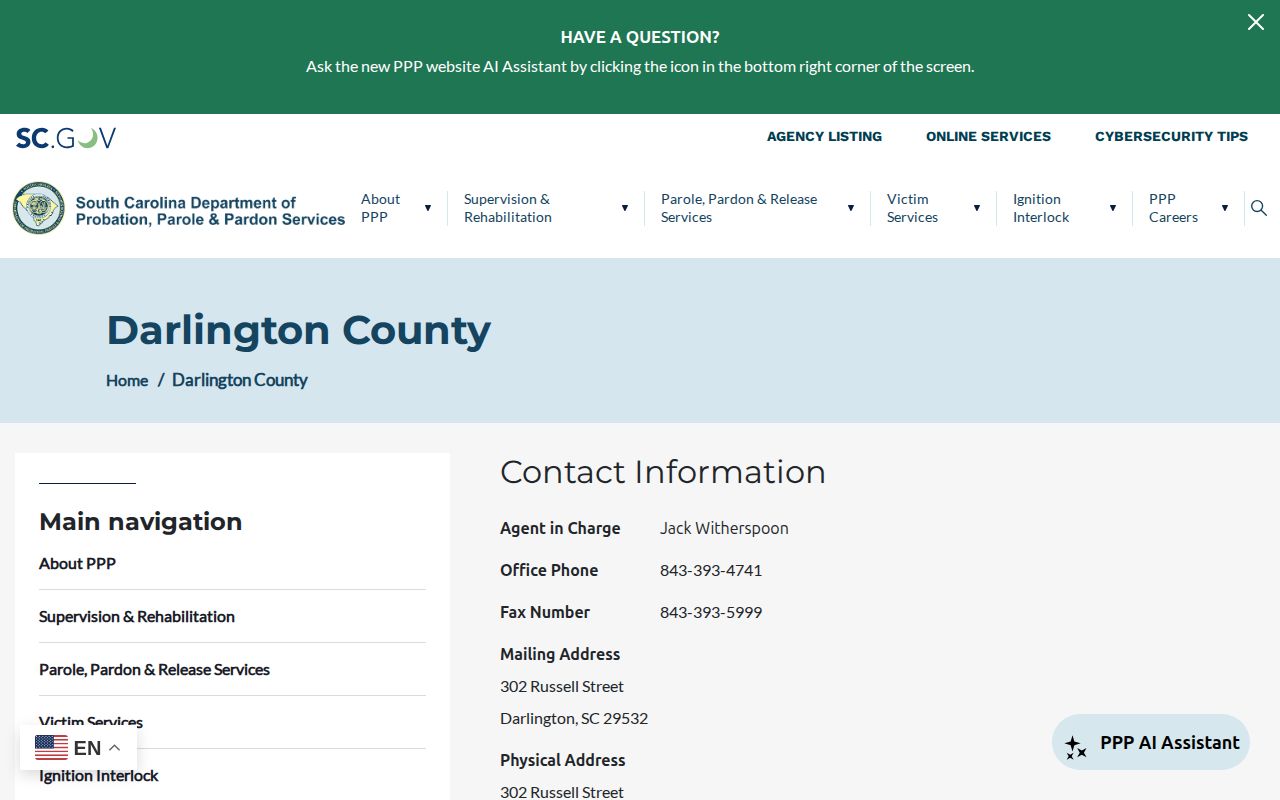
The office card is the local point for checking current contact information after a public supervision result is matched.
Darlington Parole Decisions and Release
The South Carolina Board of Probation, Parole and Pardon Services conducts parole hearings, while SCDPPPS handles administration and community supervision. The agency’s live parole-hearing search accepts first name, last name, SCDC number, and hearing month in allowed combinations. SCDPPPS says hearing dates are normally finalized and searchable about thirty days ahead, but a reader should check again for rescheduling.
A scheduled hearing is only consideration. A grant is a favorable decision, yet it is still not the physical release time. Release planning, conditions, another hold, or a detainer may intervene. Published decision concepts include granted and denied, while agency materials also recognize continuance, deferral, postponement, waiver, and later revocation or modification. Use the exact label on the live result.
Section 24-21-610 supplies the general eligibility framework. Qualifying nonviolent cases can reach consideration after one-fourth of the term. Violent cases generally use one-third or the mandatory minimum, whichever is longer. Life or long terms have separate rules, and murder, armed robbery, drug trafficking, and statutory no-parole offenses have specific bars. Eligibility never promises release.
Darlington Supervision Violations and Warrants
Conditions depend on the order and status. At a high level, they can require reporting, lawful conduct, approved movement, payment or program compliance, and adherence to special terms. Public search data should not be stretched into details that the agency has not released. For the operative terms, consult the court order, parole certificate, or SCDPPPS.
Under §24-21-680, a parole agent may issue a warrant or citation alleging a violation. The allegation, the warrant, the Board’s revocation decision, and any new jail booking are separate records. SCDPPPS also publishes a selective Most Wanted page whose cards may say “AT LARGE” or “CAPTURED.” It is not a full warrant database. The absence of a Darlington card does not prove that no warrant exists.
An absconder label requires an official source. A missed call, an old address, or a failed name search cannot support that conclusion. If a violation results in custody, verify the receiving agency rather than assuming that the person returned to the same Darlington facility.
Darlington Supervision Status Alerts
SC VINE covers adults in county detention, SCDC custody, and SCDPPPS community supervision. Search by name and use a middle initial, birth date, or offender number to reduce namesake errors. A VINE status is an agency-fed lead. No result may reflect timing, a transfer, an exclusion, or a mismatch, so the originating agency remains the source for confirmation.
Telephone, email, text, app, and TTY options may be offered. Automated phone calls use a four-digit PIN and can continue for up to 48 hours or until the PIN is entered. Email and text do not use that PIN. Parole-hearing notice has its own SCDPPPS registration route, and an SCDC crime victim seeking official notices must register with the SCDC Division of Victim Services at 1-800-835-0304.
When Darlington Supervision Ends
Release from a building and discharge from legal control are different dates. Parole continues under §24-21-670 through the unexpired term unless lawfully ended. Probation ends according to the sentencing order and any later court action. Community supervision follows its statute and agency record. A completed term can cause a person to disappear from the current SCDPPPS search.
For proof, identify the exact record needed. A court order can establish the end of probation. SCDPPPS may hold a discharge record for agency supervision. SCDC’s released search can show a prison release type and date but does not by itself prove that every later condition ended. A Darlington jail release entry only establishes movement from that jail. Matching the status, agency, and date prevents a physical exit from being confused with final discharge.
Darlington Court and Supervision Records
A probation result should be compared with the sentencing case because SCDPPPS and the court answer different questions. Darlington County is in South Carolina’s Fourth Judicial Circuit. Its Public Index can show charges, bond activity, dispositions, sentences, and filed orders, subject to public-access limits. The Clerk of Court’s General Sessions division receives, indexes, and houses criminal warrants, bond papers, and motions, and it reports dispositions to SLED while working with the sheriff and SCDC.
Search every case number tied to the person rather than stopping at the first name match. A sentence may place the person on probation at once, follow a jail term with probation, or later be changed through a revocation order. The docket is not a real-time supervision feed, but it can establish the legal source and length of probation. SCDPPPS shows the current agency status. When the two appear inconsistent, compare the filing date with the state search’s prior-day update and ask the owning office about the public record.
Parole follows a different paper trail. The Board hearing search and published decision identify the agency action, while the SCDPPPS result shows community supervision after release. A grant can be followed by conditions, planning, or another hold. For that reason, neither a hearing entry nor a favorable decision should be reported as the moment someone left an SCDC institution.
Prove Darlington Supervision Discharge
Choose the record that matches the status. A final court order is the strongest source for a probation change made by a judge. SCDPPPS is the proper agency for its supervision and discharge information. An SCDC released-list entry can establish a state-prison release type and date, but the values SUPV RE-ENTRY and PROBATION show why release from incarceration may lead into continued community control.
South Carolina FOIA permits requests for existing public records, subject to exemptions and redactions. A focused request should name the person, identifier if known, supervision type, approximate date range, and exact existing document sought. Asking for a discharge record is clearer than asking an office to research a person’s entire history or draw a legal conclusion.